When Convenience Costs You Everything: The Hidden Toll of Relying on Your Smartphone at Life's Most Important Moments
There is a particular kind of regret that does not announce itself immediately. It arrives quietly, sometimes years later, when you reach for a photograph from a day that mattered enormously — and find something that barely resembles what you remember feeling. The colors are flat. The focus is soft. The moment that once made your chest ache with joy now looks like a casual Tuesday afternoon. This is the hidden cost of convenience, and it is one that far too many families discover only when it is far too late to do anything about it.
The smartphone has done something remarkable to our collective relationship with photography. It has democratized the act of image-making in ways that were genuinely unimaginable two decades ago. Nearly every adult in the United States now carries a device capable of producing a recognizable photograph in under a second. That accessibility is not without value. But it has also created a deeply misleading cultural narrative — one that suggests the gap between a casual snapshot and a professionally crafted image is negligible, or perhaps nonexistent.
It is not. Not even close.
The Illusion of Readiness
When couples begin planning their weddings, or parents start organizing a milestone anniversary celebration, one of the most common early decisions involves the question of photography. And increasingly, a portion of that conversation ends with a version of the same conclusion: We have our phones. We'll be fine.
This reasoning feels sound on the surface. Modern smartphones produce images that look genuinely impressive when viewed on a screen at thumb-size. Social media platforms are flooded with phone-captured images that receive thousands of likes and sincere compliments. The feedback loop of digital sharing has trained the eye to accept compressed, algorithmically enhanced images as the standard of photographic quality.
But what that feedback loop cannot replicate is the experience of printing a wedding portrait at a size worthy of framing — or discovering, during the printing process, that the image lacks the resolution to hold together beyond a few inches. It cannot simulate the feeling of reviewing hundreds of reception photos and realizing that not one of them captured the exact expression on your mother's face when you walked down the aisle. These are not abstract concerns. They are documented, recurring experiences shared by families across the country who made the convenience calculation and found it wanting.
What a Lens Actually Sees
Professional photographers working in the wedding and event space operate with equipment engineered specifically to solve problems that smartphone cameras are not designed to address. Low-light environments — the dimly lit reception hall, the candlelit ceremony, the golden-hour outdoor portrait — require sensors of a size and sensitivity that no current smartphone can match. The physics are simply not comparable.
Beyond hardware, the professional brings something that no device can manufacture: the trained capacity to anticipate. A seasoned photographer has spent years learning to read a room, to recognize the micro-expressions that precede genuine emotion, and to position themselves in the precise location where the light and the subject and the moment will converge. That is not a feature you can download. It is a craft developed through thousands of hours of deliberate practice and refined through the hard lessons that come with professional accountability.
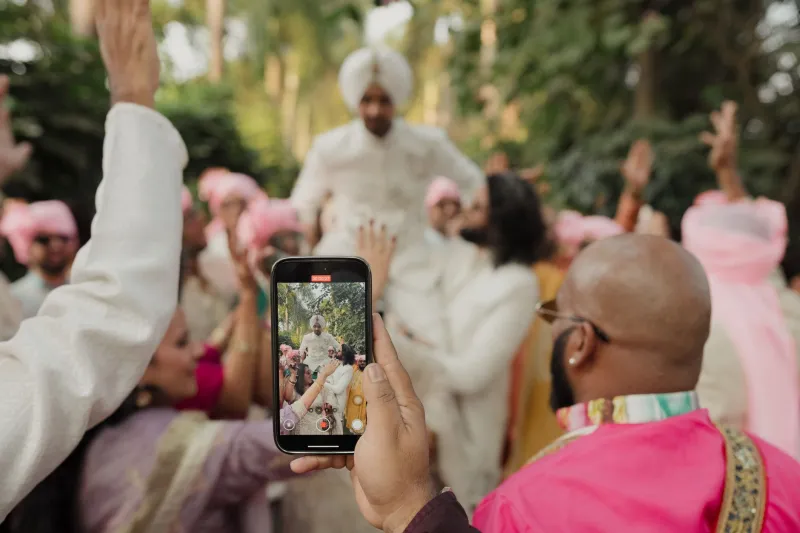
Smartphone photography, however technically impressive its output may appear on a small screen, is fundamentally reactive. It captures what is already happening, often from wherever the person holding the phone happens to be standing. Professional photography is anticipatory. It shapes the conditions under which the moment occurs, ensuring that when it does, the camera is exactly where it needs to be.
The Archival Question Nobody Asks
There is another dimension to this conversation that rarely surfaces until it becomes urgently relevant: the long-term durability of the images themselves.
Professional photographers deliver work in formats designed for permanence. High-resolution files, properly color-corrected and stored with archival best practices in mind, are built to survive the decades. They can be printed at large scale, reproduced in albums, and transferred across generations without meaningful degradation.
Smartphone images, by contrast, exist in a precarious digital ecosystem. They are stored on devices that break, get lost, or become obsolete. They are uploaded to cloud services whose business models and data retention policies are subject to change. They are compressed by social media platforms in ways that strip away the very detail that makes an image worth preserving. The grandmother who wants a framed portrait from her granddaughter's wedding deserves more than a screenshot pulled from an Instagram story.
This is not a hypothetical risk. It is the lived reality of families who trusted their most important moments to the path of least resistance.
The Psychology of 'Good Enough'
Perhaps the most insidious element of the smartphone photography trap is the way it exploits a very human cognitive tendency: the preference for immediate, tangible savings over diffuse, future costs. When a couple looks at their wedding budget and considers the line item for professional photography, the cost is concrete and present. The value being protected — the irreplaceable visual record of one of the most significant days of their lives — is abstract and future-facing.
This asymmetry makes it genuinely difficult for many people to prioritize photography appropriately. The money saved feels real. The quality lost feels theoretical. Until the day arrives when the images are all that remain of the moment, and their limitations become impossible to rationalize away.
Cultural messaging compounds the problem. We live in an era that celebrates the effortless, the spontaneous, and the authentic — values that map conveniently onto casual phone photography. But there is a meaningful distinction between authenticity and negligence. A professional photographer does not manufacture false emotion or construct artificial moments. What they do is create the technical and relational conditions under which genuine emotion can be captured with fidelity and preserved with care.
Investing in What Endures
The photographs taken at your most important events will outlast the flowers, the food, the music, and in many cases the people who were present. They will be the primary means by which future generations understand who you were, what you valued, and how you loved. That is not a responsibility that should be delegated to a device designed primarily for sending text messages.
At Two15 Photography, we have spent years working alongside families during the moments that define their stories. We have seen the difference that intentionality, technical mastery, and genuine investment in the craft can make — not just in the quality of the images, but in the experience of looking at them years later. The convenience of the smartphone is real. But so is the cost of mistaking convenience for preparation.
Some moments deserve more than a tap on a screen. They deserve someone whose entire professional purpose is to ensure that the photograph does justice to the day.