Standing Where It Counts: How a Photographer's Position Shapes the Story of Your Most Important Day
There is a particular cruelty in watching a video someone shot on their phone at a wedding ceremony. The subject is correct — two people exchanging vows, surrounded by the people they love most. But the framing is wrong. The angle is wrong. Somebody's elbow drifts into the shot. The audio cuts in and out. And the moment that was supposed to last a lifetime has been rendered into something you can barely bring yourself to watch twice.
This is not about technology. Modern smartphones are genuinely capable devices. The problem runs deeper, and it has everything to do with where a person is standing, what they have trained themselves to anticipate, and whether they arrived at the ceremony with the singular intention of capturing it — or simply attending it.
The Architecture of a Ceremony, Seen Through a Professional's Eyes
When a professional photographer arrives at a venue, the first thing they do is not pick up their camera. They read the room. They study the light sources, identify where the couple will stand, trace the path the wedding party will walk, and calculate where the most emotionally resonant moments are likely to unfold. This process — quiet, methodical, and invisible to guests — determines everything about the photographs that will eventually emerge.
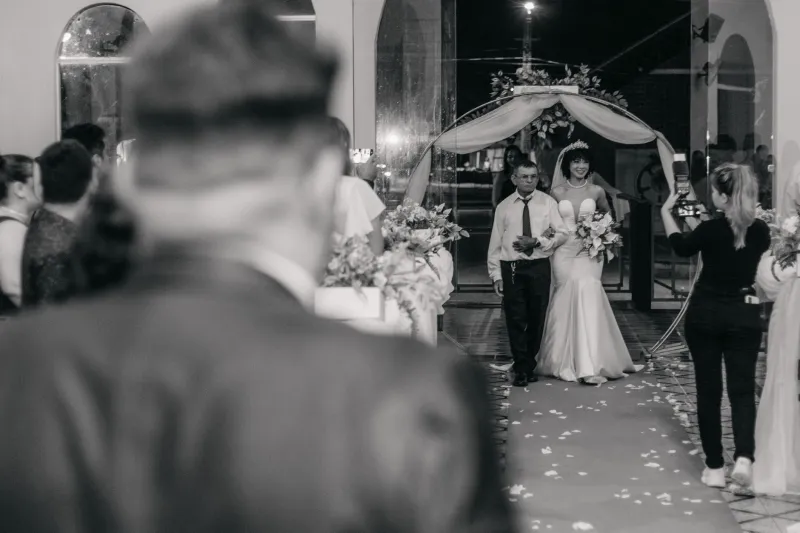
A guest sitting in a pew, no matter how well-meaning, is constrained by their seat assignment. They see the backs of heads. They see the officiant's face, perhaps, and occasionally a profile of the couple if the aisle is wide enough. What they cannot see is the expression on the groom's face when the doors open and his bride appears. They cannot see the flower girl pause and look up with wide eyes. They cannot see the mother of the bride press a tissue to her cheek in the second row.
A professional photographer has already positioned themselves to capture all of it.
Anticipation as a Technical Skill
One of the least discussed but most important aspects of professional photography is the ability to anticipate. This is not intuition in any mystical sense — it is the result of having photographed dozens, sometimes hundreds, of similar events. A photographer who has covered fifty wedding ceremonies knows that the ring exchange almost always produces an involuntary smile from the groom before the formal moment arrives. They know that the first kiss is rarely the most compelling shot; the two seconds afterward — when the couple separates and looks at each other for the first time as a married pair — often yields something far more powerful.
This knowledge shapes positioning. The photographer is not reacting to moments; they are already in place for them. A guest with a phone is, by definition, always reacting. By the time they raise the device, unlock it, open the camera application, and frame the shot, the moment has moved on.
The Emotional Cost of Secondhand Coverage
There is a practical argument for professional photography, and there is an emotional one. The emotional argument is perhaps more urgent.
When you are standing at the altar, you are not supposed to be thinking about documentation. You are supposed to be present — absorbing the weight and the joy of the moment, looking at the person across from you, and letting the experience settle into your memory in the way that only full attention allows. The presence of a skilled photographer is designed to be invisible. Their job is to witness without intruding, to capture without interrupting, so that you can be entirely where you are.
Guests who record on their phones cannot offer this. In fact, their presence with devices raised actively degrades the experience — both for the couple and for themselves. The guest who spends the ceremony staring at a four-inch screen is not experiencing the ceremony. They are producing a low-quality document of it. And when they share that document, they are offering the couple a version of their own wedding that feels distant, accidental, and incomplete.
Vantage Points That Cannot Be Improvised
Professional photographers work with venue coordinators, officiants, and event staff to secure positions that guests simply cannot access. They may stand at the base of the altar steps during the vow exchange. They may move to a balcony or elevated position to capture a wide establishing shot of the entire ceremony space. They may position a second shooter at the opposite end of the aisle to capture simultaneous perspectives — the couple walking toward one lens while another lens records the guests' expressions as the procession passes.
None of this is improvised on the day. Experienced photographers visit venues in advance, review floor plans, and communicate with the couple about which moments carry the most personal significance. If the grandmother of the bride is seated in a specific location and her reaction to the vows is something the couple wants preserved, that information shapes the photographer's movement plan for the entire ceremony.
A guest with a phone has none of this infrastructure. They have a seat, a device, and good intentions. Good intentions do not produce great photographs.
What You Are Actually Paying For
When couples invest in professional wedding photography, they are sometimes uncertain about what exactly justifies the cost. The answer, in part, is access — access to skill, equipment, and experience. But in equal measure, the answer is position.
You are paying for someone who will be standing in exactly the right place, at exactly the right moment, with a lens and a camera body capable of rendering that moment in full detail, regardless of whether the light is ideal or the venue is challenging. You are paying for someone who will not flinch when the flower girl changes course unexpectedly, or when the best man drops the ring and the entire ceremony pauses for a beat of collective anxiety. You are paying for someone who reads those seconds of chaos and finds the photograph inside them.
That is not a service a guest can provide. It is not something that can be crowdsourced across a room full of well-meaning people with phones. It requires training, preparation, and the kind of deliberate positioning that only comes from treating photography as a serious craft.
The Photographs You Will Actually Return To
Years from now, the photographs you return to will not be the ones shot from the fourth row on a smartphone. They will be the ones where the light falls correctly across a face, where the composition draws your eye to what matters, where the moment feels not merely documented but genuinely seen.
Those photographs come from a photographer who understood, before the ceremony began, where they needed to be standing — and why.