The Art of Ease: What Professional Photographers Do Differently to Capture Genuine Emotion from Reluctant Subjects

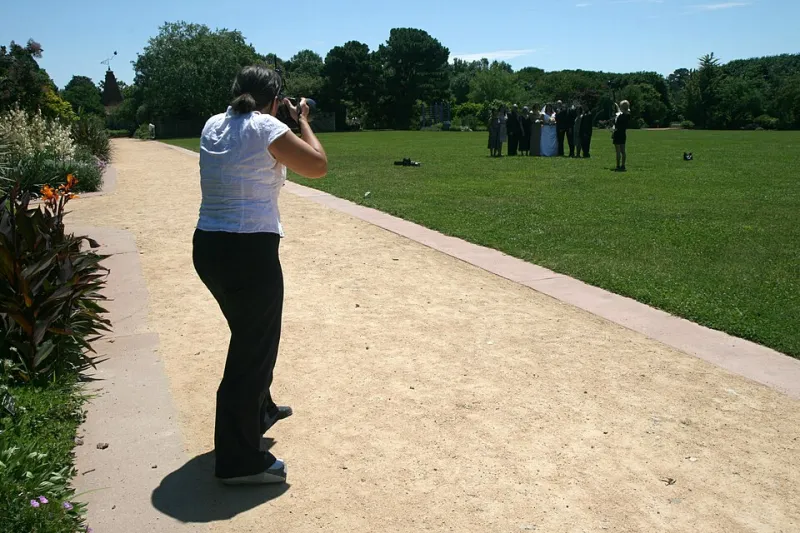
Photo: Basher Eyre , CC BY-SA 2.0, via Wikimedia Commons
The warning usually comes during the initial consultation. "I'm not photogenic." "I never know what to do with my hands." "Every photo of me looks terrible." It arrives with a self-deprecating laugh, but the anxiety behind it is genuine — and it is far more common than most people realize.
Camera shyness is not a personality flaw. It is a near-universal human response to a specific kind of social pressure: the awareness of being observed and evaluated, combined with the knowledge that the result will be permanent. Understanding that is the first thing a skilled photographer must do. The second is knowing exactly how to dissolve it.
Why People Freeze in Front of a Camera
Before exploring technique, it helps to understand the psychology. When a camera is raised, most people immediately enter a state of heightened self-consciousness. They begin to monitor themselves from the outside — imagining how they appear rather than simply being present. Psychologists sometimes call this objective self-awareness, and it tends to produce exactly the kind of stiff, performative expression that makes people cringe at photographs of themselves.
The challenge for a photographer is not to eliminate this response — that would be nearly impossible — but to redirect the subject's attention away from the camera and back toward something real. Genuine emotion cannot be manufactured. It can only be invited, and the invitation requires patience, skill, and a certain quality of human presence that goes well beyond technical expertise.
The First Fifteen Minutes Are Everything
Experienced photographers will tell you that the quality of a session is often determined before a single frame is captured. The way a photographer introduces themselves, the questions they ask, the energy they bring into a room — all of it shapes how comfortable a subject will feel when the lens is finally pointed at them.
At Two15 Photography, we approach every new client relationship with the understanding that trust is the foundation of every meaningful photograph. During early conversations, we ask about the people in the wedding party, the family dynamics, the things that make the couple laugh. Not because we need this information for logistical purposes, but because it tells us something about the emotional texture of the day — and because the act of being genuinely curious about someone begins to dissolve the professional distance that makes people feel like subjects rather than participants.
By the time the camera comes out, a good photographer should feel less like a stranger and more like a familiar presence. That familiarity changes everything.
Movement Over Stillness
One of the most effective tools in a photographer's arsenal for working with self-conscious subjects is deceptively simple: keep them moving. The posed, stationary portrait — "stand here, look at the camera, smile" — is precisely the format most likely to trigger the freeze response. It asks people to perform rather than exist.
Directing subjects through gentle, purposeful movement shifts their attention from how they look to what they are doing. Walk toward each other. Hold hands and take a slow turn. Lean in and say something that makes your partner laugh. These are not elaborate choreographies — they are small invitations to be in relationship with another person rather than in relationship with the camera.
The photographer's job during these moments is to disappear as much as possible. Speak quietly. Move deliberately. Avoid drawing attention to the act of shooting. Some of the most powerful images from any wedding day are captured in the margins — in the transitions between formally directed moments, when people exhale and return to themselves.
Reading the Room at Events
Weddings and large events introduce a different layer of complexity. A photographer is not working with one or two subjects but with dozens — each at a different point on the comfort spectrum, each with their own relationship to the camera.
The skill here is observation. Before raising the camera, experienced photographers spend time simply watching. They identify the uncle who performs for every lens, the grandmother who turns away, the best friend who becomes genuinely herself when she thinks no one is looking. These observations inform every compositional decision made throughout the day.
For group portraits — often the most dreaded portion of any wedding — the goal is efficiency and warmth in equal measure. Moving through the logistics quickly reduces the opportunity for anxiety to build. A light comment, a small joke, a genuine compliment offered at the right moment can shift the collective energy of a group in seconds. Photographers who are skilled at working with people understand that humor and ease are not unprofessional — they are essential tools.
When Someone Truly Cannot Relax
Occasionally, despite every technique, a subject remains locked in self-consciousness. In these cases, the best approach is often to stop trying to photograph them directly for a while. Step back. Engage them in conversation. Point the camera elsewhere for a few minutes.
The paradox is that people tend to relax most completely when they believe they are no longer being watched. A photographer who has built genuine rapport can often catch this moment — the slight drop of the shoulders, the natural return of expression — and capture it quietly before the subject realizes the camera has returned.
This requires a kind of peripheral awareness that takes years to develop. It also requires the willingness to prioritize the subject's experience over the photographer's convenience. The best images are rarely the ones that were easiest to take.
The Result: Photographs That Feel Like Memory
When these techniques work — and in the hands of an experienced photographer, they almost always do — the resulting photographs have a quality that is immediately recognizable. They do not look posed. They do not look performed. They look like life, caught in a moment of genuine feeling.
That is the goal. Not a perfect smile, but a real one. Not a flawless composition, but an honest one. The people who look at these photographs years from now will not remember the anxiety that preceded them. They will only see themselves as they truly were — present, connected, and alive in the moment.
And that is precisely what a photograph should be.