Drowning in Storage, Starving for Meaning: How Auto-Backup Is Quietly Replacing Real Memories

There is a particular kind of confidence that comes from watching your phone display a small notification: Backup complete. It arrives quietly, almost imperceptibly, after a birthday dinner or a graduation ceremony or a wedding reception. In that moment, something feels resolved. The day has been captured. The memory is safe.
Except it isn't. Not really.
The gap between storing a photograph and preserving a memory is wider than most people ever stop to consider — and the consequences of confusing the two are felt most acutely during the events that matter most.
The Illusion of Automatic Preservation
Cloud storage services like iCloud, Google Photos, and Amazon Photos have fundamentally reshaped how Americans relate to their personal image libraries. The promise is elegant in its simplicity: take a photo, and it will be saved automatically, indefinitely, without any effort on your part. No more lost rolls of film. No more corrupted hard drives sitting in a closet. No more catastrophic losses when a phone falls into a pool.
The technology works exactly as advertised. The problem lies in what we have come to believe that technology delivers.
When a backup completes, we feel as though we have done something — as though the act of capturing and storing an image carries the same weight as the act of truly preserving a moment. But preservation is not a passive process. It is an intentional one. A photograph sitting unsorted in a cloud library alongside 47,000 other photographs is not a preserved memory. It is a needle in an ever-expanding haystack.
Research into human memory consistently demonstrates that photographs derive their power from retrieval, not storage. A photo you never look at again does not reinforce a memory. It does not anchor an emotional experience. It simply exists, invisible and inert, in a database you will likely never scroll to the bottom of.
How the Backup Trap Unfolds
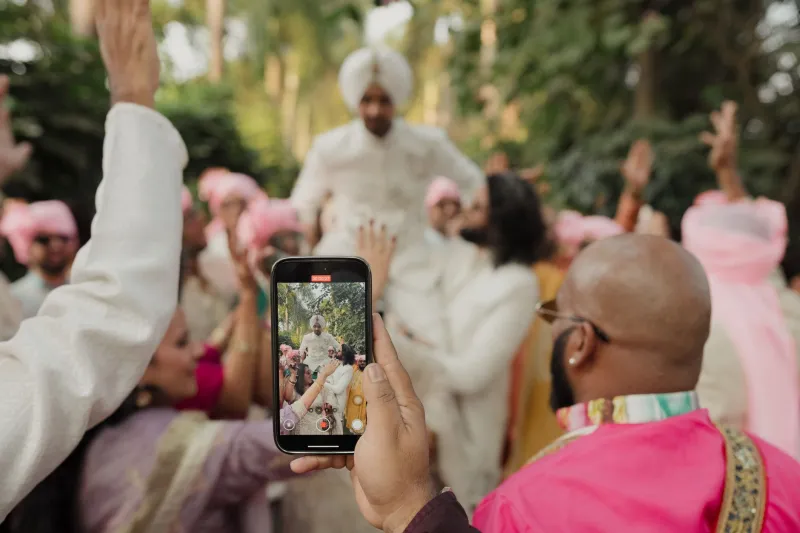
The pattern tends to follow a predictable arc. An important event occurs — a milestone birthday, a corporate gala, a child's first recital. Attendees photograph it casually, trusting their devices to handle the rest. The photos back up automatically. Life resumes.
Months pass. The images become buried beneath thousands of subsequent snapshots: screenshots of restaurant menus, blurry photos of parking spot numbers, accidental captures of the inside of a pocket. Retrieval becomes a project in its own right, requiring time and energy that almost no one allocates. The photos from that important evening are technically accessible, but functionally invisible.
Worse still, the quality of those automatically captured images rarely reflects the significance of the occasion. Smartphone cameras have improved dramatically, but they remain reactive instruments. They capture what is directly in front of them under whatever conditions happen to exist at that moment. They do not compose. They do not anticipate. They do not understand the difference between a forgettable Tuesday and the most consequential evening of someone's life.
The result is a digital archive full of images that document an event without ever truly capturing it.
Why Important Events Deserve More Than Passive Documentation
Consider the difference between a photograph taken because someone happened to have a phone in their hand and a photograph taken because a skilled professional recognized a moment worth preserving.
The first image exists by accident. The second exists by design.
Professional photography is, at its core, an act of sustained intentionality. A professional photographer arrives at an event having already thought carefully about light, about timing, about the emotional arc of the occasion. They are not waiting for a notification to confirm that their work is saved. They are actively constructing a visual record that will remain meaningful years and decades from now — one that can be printed, framed, shared, and returned to with genuine feeling.
There is a reason that professionally photographed events feel different when you look back at them. The images were made with purpose. Every frame was a deliberate choice rather than a reflexive tap on a glass screen.
The False Economy of Doing It Yourself
One of the most common justifications for skipping professional photography at significant events is cost. Smartphones are already paid for. Cloud storage is either free or inexpensive. Why invest in something that technology has apparently already solved?
This reasoning makes sense until you examine what it actually produces.
The average American's photo library contains thousands of images they have never meaningfully revisited. Studies suggest that the sheer volume of digital photographs people accumulate actively diminishes the emotional resonance of any individual image. When everything is saved, nothing feels worth saving. When every moment is documented, no single moment feels truly documented.
Professional photography operates on an entirely different principle. A curated, expertly captured gallery of images from a wedding, a corporate event, or a family milestone is not competing with thousands of other images for your attention. It is the record. It is the thing you return to. It is the version of that day that will be passed down, displayed, and remembered.
The cost of professional photography, measured against the cost of losing a meaningful visual record of an irreplaceable event, is not a close comparison.
What Intentional Documentation Actually Looks Like
At Two15 Photography, we have spent years working alongside clients who arrive at important moments with the best of intentions and the wrong tools. We have seen the disappointment that follows when someone realizes, months after a significant occasion, that the only photographs they have are blurry, poorly lit, and buried somewhere in a cloud library they cannot easily navigate.
We have also seen what happens when those same clients choose intentional documentation. They receive a carefully edited gallery of images that reflect the genuine emotional weight of the occasion. They can print those images. They can display them. They can share them with family members who were not present. They can look at them ten years from now and feel something real.
That outcome does not happen by accident. It does not happen because a phone happened to be pointed in the right direction at the right moment. It happens because someone with skill, experience, and genuine investment in the result was present and paying attention.
The Notification That Doesn't Tell the Whole Story
The next time your phone displays that small, reassuring message — Backup complete — it is worth pausing for a moment to ask what, exactly, has been preserved.
The files are safe. The storage is secure. But the memory, the feeling, the irreplaceable texture of that particular moment in your particular life — that is not something any backup service can guarantee.
True preservation requires intention. It requires craft. And for the moments that genuinely matter, it requires a professional who understands that capturing a moment and simply recording it are two entirely different things.