What You Lose When You Hand the Camera to a Guest: The True Price of Skipping a Professional Photographer
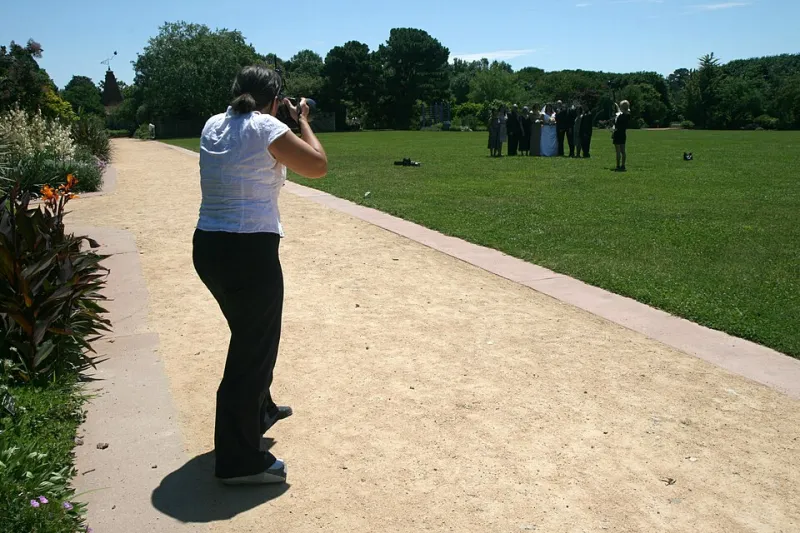
Photo: Ildar Sagdejev (Specious), CC BY-SA 4.0, via Wikimedia Commons
There is a particular kind of regret that arrives quietly, usually weeks after the celebration has ended. The venue has been cleaned, the flowers have wilted, and the guests have returned to their ordinary lives. It arrives when you finally sit down to look at the photographs — and find that what you have does not come close to capturing what you felt.
At Two15 Photography, we have heard this story more times than we can count. Couples who entrusted their wedding reception to a well-meaning uncle with a new DSLR. Families who asked a coworker to document a milestone anniversary party. Corporate clients who assumed a smartphone and a steady hand would be sufficient for a product launch. In nearly every case, the conclusion is the same: the images fell short, and the moment is now gone.
This article is not intended as a sales pitch. It is an honest examination of what genuinely disappears when professional photography is removed from your event equation — and why that loss extends well beyond the photographs themselves.
The Emotional Weight Nobody Warns You About
One of the most overlooked consequences of DIY event photography is the psychological burden it places on the people involved. When someone at the event — whether a guest, a family member, or the host themselves — takes on the role of photographer, they are no longer fully present. They are operating in two worlds simultaneously: the world of the celebration and the world of documentation.
Consider a bride who decides to rely on a combination of a photo booth and guests' smartphone cameras to keep costs down. Throughout the reception, she finds herself glancing around the room, wondering whether anyone captured her father's toast, whether the first dance was properly framed, whether the candid moment she shared with her grandmother was documented at all. Instead of surrendering to the joy of the evening, she is managing invisible logistics. The celebration continues around her, but she is only partially in it.
This phenomenon extends to the person assigned the camera. A guest who genuinely wants to help will spend the evening stressed, second-guessing compositions, and worrying about storage space on their memory card. They miss the dinner conversation. They step away during the speeches. They are neither a comfortable guest nor a capable photographer — they are caught somewhere in between.
Technical Failures That Cannot Be Undone
Beyond the emotional dimension lies a set of purely technical realities that amateur photographers, regardless of their enthusiasm or equipment, are simply not equipped to overcome.
Lighting is perhaps the most unforgiving of these challenges. Professional event spaces are rarely designed with photography in mind. Ballrooms rely on warm, low-level ambient lighting that flatters the eye but confounds a camera sensor. Outdoor ceremonies shift from harsh midday sun to deep shadow within minutes. Indoor venues mix tungsten, fluorescent, and natural light sources in ways that produce muddy, color-cast images without careful correction.
A professional photographer arrives with an understanding of these variables and the tools to address them — off-camera flash, light modifiers, knowledge of when to use available light and when to supplement it. An amateur arrives with a camera and good intentions.
Focus and timing present similar obstacles. The moment a flower girl's expression transforms from nervous concentration to pure delight lasts perhaps half a second. Capturing it requires anticipation, familiarity with the equipment, and the muscle memory that comes from documenting dozens of events. No amount of enthusiasm compensates for that experience gap.
Then there is post-processing. The images captured on any given evening are only the beginning. Color grading, exposure correction, retouching, and the careful selection of images from hundreds or thousands of frames — this is the work that transforms raw captures into the polished photographs that end up on your walls and in your albums. It is skilled, time-consuming labor that most guests or well-meaning volunteers are neither trained nor equipped to perform.
Stories From the Other Side of the Lens
One client who came to us after a difficult experience described her sister's wedding with genuine sadness. The family had decided to allocate the photography budget toward catering upgrades, reasoning that the food would be enjoyed in the moment while photographs were, in their words, "just extras." A family friend with a mirrorless camera volunteered to cover the event.
The resulting images were technically adequate in some cases and deeply flawed in others. The ceremony photographs were underexposed — the church's stained glass windows had fooled the camera's metering system. The first dance was captured in a series of motion-blurred frames. The only sharp, well-lit photographs from the entire evening were taken in the cocktail hour, when guests were gathered near large windows in natural afternoon light.
"We thought we could always go back and recreate some of the shots later," she told us. "But you can't recreate the look on my mother's face when my sister walked down the aisle. You can't recreate that."
Another client, a corporate event director at a mid-sized firm in the Pacific Northwest, shared a similar account regarding a product launch that had been documented entirely on company-issued smartphones. The images, while passable for internal communications, were wholly unsuitable for the press releases and marketing materials the team had planned to distribute afterward. The company ultimately invested in a reshoot — at a cost that significantly exceeded what a professional photographer would have charged on the original event date.
What Professional Photography Actually Provides
It is worth naming, clearly, what a professional photographer brings to an event beyond technical competence.
They bring invisibility. A skilled photographer moves through a celebration without disrupting its rhythm, capturing authentic moments precisely because guests have forgotten they are being observed. They bring a second set of eyes — the ability to notice the grandmother dabbing at her eyes in the corner while the rest of the room watches the couple cut the cake. They bring experience with the unexpected: the sudden rainstorm, the ceremony that runs thirty minutes late, the lighting rig that fails an hour before the reception begins.
Perhaps most importantly, they bring the gift of full presence to the people being celebrated. When you know the documentation is handled, you are free to inhabit the moment entirely. That freedom is not a luxury. For events that mark the most significant passages of your life, it is essential.
At Two15 Photography, our commitment is to ensure that when you look back on your most important moments, the images you find are worthy of the experiences they represent. Because some moments genuinely do not come around twice — and the photographs that remain are the closest thing we have to returning to them.