Before the Big Day: Why More Couples Are Practicing for Their Wedding Photos — and How You Can Too
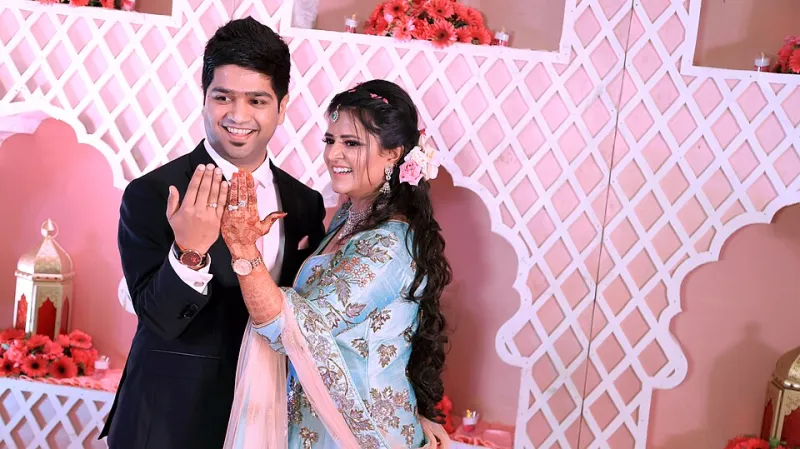
Photo: Shuttersmile2011, CC BY-SA 4.0, via Wikimedia Commons
Amanda and Derek had photographed well exactly once in their lives — at a cousin's birthday party, when neither of them knew they were being photographed. Every other image they had of themselves together looked, in Amanda's words, "like we were being held at gunpoint and trying to seem relaxed about it."
This is not an uncommon situation. Most people move through their lives without ever developing a working relationship with a camera. Then, suddenly, their wedding day arrives — arguably the most photographed day of their lives — and they are expected to perform naturally, joyfully, and with apparent ease in front of a professional lens for eight to ten consecutive hours.
The results, when couples are entirely unprepared, are often technically competent but emotionally hollow. The light is correct. The composition is sound. But something essential is missing: genuine comfort.
The good news is that comfort in front of a camera is not a personality trait. It is a skill, and it can be learned.
A Trend Taking Root Across the Country
Over the past several years, a meaningful shift has occurred in how engaged couples approach their wedding photography. Rather than treating the wedding day itself as their first real experience with a professional photographer, more couples are investing time and energy into preparation well in advance.
This preparation takes several forms. Some couples attend brief photography workshops offered by local studios or community arts organizations in cities like Austin, Denver, and Atlanta. Others schedule intentional engagement sessions not merely to produce a set of shareable photos, but explicitly as a rehearsal — a low-stakes environment in which to learn how they move, how they interact with each other on camera, and how to work with their specific photographer's direction.
Still others take a more independent approach, studying reference images together, practicing poses in front of a mirror, and having candid conversations with their photographer about insecurities and preferences before the wedding day ever arrives.
All of these approaches share a common outcome: couples who arrive at their wedding day with a foundational understanding of what it feels like to be photographed professionally. And that foundation, however modest, changes everything.
What Actually Makes Someone Photograph Well
There is a persistent myth that photogenic quality is innate — that some people simply have "it" while others do not. Professional photographers understand this to be largely false. What reads as photogenic in a finished image is almost always the product of specific, learnable behaviors.
Posture and body awareness account for an enormous proportion of how a person appears on camera. Slight adjustments — drawing the chin fractionally forward and downward, relaxing the shoulders away from the ears, creating subtle separation between the arms and torso — produce dramatic differences in how a person looks in a photograph. These are not complex techniques. They simply require awareness, which most people lack until someone teaches them.
Authentic micro-expressions are what separate images that feel alive from those that feel performed. A genuine smile engages the muscles around the eyes — what researchers call a Duchenne smile — in a way that a posed smile does not. Photographers who understand this work to create real moments rather than request artificial expressions. Couples who understand this can actively participate in creating those moments rather than waiting passively to be directed.
Physical comfort with a partner is perhaps the most underestimated factor. Many couples, when placed in front of a camera together, become subtly formal with each other. The physical ease and natural affection that characterizes their private relationship retreats behind self-consciousness. Practice sessions help dissolve this dynamic by making the camera feel like a familiar presence rather than an intrusive one.
Real Preparation, Real Results
Jordan and Marcus, a couple who worked with Two15 Photography on their ceremony in Savannah, Georgia, scheduled two separate pre-wedding sessions with their photographer. The first was a standard engagement session at Forsyth Park. The second, scheduled three weeks before the wedding, was an intentional rehearsal — two hours in which they explicitly focused on learning rather than producing images.
"We talked through every insecurity we had," Jordan recalled. "I hate how I look when I laugh too wide. Marcus tends to go stiff when he knows someone's watching him. By the time the wedding came, our photographer already knew all of that. She knew exactly how to work with us."
The wedding images reflected that preparation. Rather than the careful, slightly wooden portraits that characterize so many wedding galleries, their images captured genuine tenderness — the kind that is nearly impossible to manufacture but entirely possible to reveal, given the right conditions.
Actionable Steps for Couples Preparing for Their Wedding Day
Regardless of budget or timeline, every couple can take meaningful steps to improve their experience in front of the camera.
Have an honest conversation with your photographer early. Share your concerns, your insecurities, and your preferences before the wedding day. A skilled photographer will use this information to shape their approach. Do not wait until the morning of the ceremony to communicate that you dislike a particular style of pose or feel uncomfortable with prolonged eye contact toward the lens.
Schedule your engagement session as a learning experience. Rather than treating it purely as a marketing opportunity for social media, approach your engagement session as a rehearsal. Ask your photographer for feedback. Ask what you can adjust. Review the images together and identify what you want to replicate — and what you want to change — on your wedding day.
Study images you love. Collect wedding photographs that resonate with you and examine why. Is it the body language? The emotional quality? The physical proximity of the couple? Developing a visual vocabulary for what you want helps you communicate more effectively with your photographer and gives you something concrete to aspire toward.
Practice being present with your partner. On the wedding day itself, the couples who photograph most beautifully are almost always those who have learned to direct their attention toward each other rather than toward the camera. Practice this in your daily life. When your photographer is working, focus on your partner — their face, their hands, the specific quality of the moment — and allow the camera to capture what is genuinely there.
Understand that imperfection is often the point. The images that couples return to most frequently, years after a wedding, are rarely the formally composed portraits. They are the candid frames — the unexpected laugh, the quiet moment before the ceremony, the unrehearsed glance. Preparation does not mean manufacturing perfection. It means becoming relaxed enough that authentic moments can surface and be captured.
The Confidence That Changes Everything
At Two15 Photography, we have observed a consistent pattern across hundreds of weddings and portrait sessions: the single greatest predictor of beautiful wedding images is not the venue, the weather, or even the light. It is the confidence of the couple in front of the lens.
Confidence, in this context, does not mean bravado or performance. It means the quiet comfort of knowing what to expect, trusting the person behind the camera, and feeling free to be genuinely present with the person you are marrying. That comfort is available to every couple willing to invest a small amount of time in cultivating it.
The camera, ultimately, does not lie. But it also does not exaggerate. What it captures, with extraordinary fidelity, is exactly what is truly there — which is precisely why preparation matters, and precisely why the couples who arrive ready are the ones whose images last a lifetime.