Reading the Room: How Your Venue Quietly Directs Every Photograph Taken Inside It
Couples spend months choosing a venue. They weigh capacity, catering, cost, and commute. Yet few realize that the space they select will quietly make more creative decisions about their wedding photographs than almost anyone else involved — including, at times, the photographer.
At Two15 Photography, we think of a venue as an uncredited member of the creative team. It sets the lighting budget, blocks the scenes, and decides which moments will glow and which will fight the camera. A professional doesn't impose a style on a location; they listen to what the location is already saying and answer in kind.
The Scout Comes Before the Shot
Long before a single frame is exposed, an experienced photographer walks the property with a different set of eyes than a couple planning table assignments. We're mapping where the sun will sit at a 4 p.m. ceremony in October. We're noting which hallway funnels guests into a beautiful compression of light and which one produces flat, fluorescent nothing. We're measuring sightlines — can the second shooter cover the aisle from a balcony, or will a support beam cut the father of the bride out of the frame at the exact wrong second?
This reconnaissance is why two photographers can shoot the same venue and produce galleries that look like they came from different planets. The one who read the room wins.
A Field Guide to Five Classic American Venues
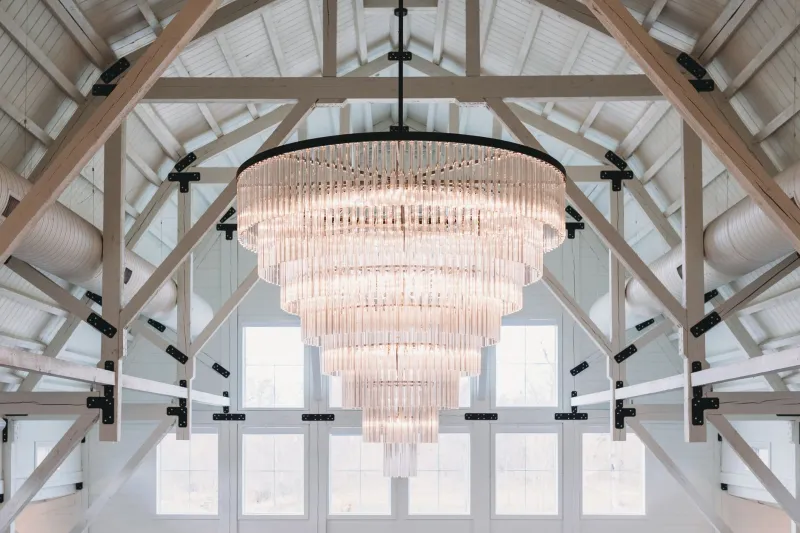
The Barn. Rustic barns, from Vermont to the Texas Hill Country, offer one of photography's great gifts: texture. Weathered wood, hanging Edison bulbs, and dust suspended in a shaft of afternoon light give every image a warm, dimensional grain. The challenge is darkness — barns are caverns. A professional leans into the mood, using off-camera flash to mimic window light and letting the beams and planks frame the couple rather than clutter behind them. Shot right, a barn gallery feels like a novel; shot wrong, it feels like a cave.
The Ballroom. Hotel ballrooms in Chicago, Dallas, or Manhattan present the opposite problem: too much polish, too little character. Crystal chandeliers and mirrored walls can flatter or flatten. Here the photographer's job is subtraction — finding the one corner where a chandelier bokeh falls behind the couple, waiting for the golden spill of uplighting during the first dance, and using long lenses to compress the grandeur into something intimate rather than institutional.
The Beach. A coastal ceremony in the Outer Banks or on California's coast hands the photographer the most powerful light source on earth — and a schedule to match. Beach light is a moving target: harsh and top-down at noon, luminous and forgiving in the hour before sunset. Wind, too, becomes a character in the story, lifting veils and hair in ways no studio could stage. Professionals time the portraits to the tide chart and the sun's descent, not the cocktail hour.
The Courthouse. A civil ceremony at a city courthouse — think the marble stairs of San Francisco City Hall or a county courthouse in the Midwest — strips the day down to its essence. The architecture is monumental, the light is often a single dramatic skylight, and the guest list is small. The venue demands restraint: wide compositions that honor the columns and staircases, quiet frames of the signatures and the witnesses, and a documentary hand that lets the stark setting amplify the intimacy.
The Rooftop. Urban rooftops deliver a skyline as a co-star, but they also deliver wind, harsh reflected light from neighboring glass towers, and a sunset that lasts about twelve minutes. The professional's playbook: scout the railings and rooftop access doors for clean backgrounds, bracket exposures against the bright sky, and schedule the skyline portraits for the narrow window when city lights flicker on and the sky still holds color.
Collaborate, Don't Conquer
The common thread across all five settings is this: the photographs improve dramatically when the photographer works with the space instead of against it. Fighting a barn's darkness with brute-force flash produces images that feel clinical. Ignoring a beach's schedule produces squinting subjects and blown-out skies. The venue always wins the argument — so the smart move is to let it lead.
For couples, this carries a practical lesson. When touring venues, ask how the light moves through the ceremony space at your ceremony time. Ask where photographers typically stand and shoot. A venue that photographs well is a venue that will keep giving back every time you open the album.
The Gallery Reflects the Ground It Stood On
Years from now, when you flip through your wedding gallery, you won't just see yourselves — you'll see the place. The barn's warmth, the ballroom's sparkle, the courthouse's gravity. Choose your venue thoughtfully, then hire a photographer who treats it as a partner. The space knows what it has to offer. The right photographer knows how to listen.